

Just found out you’re pregnant and wondering if your bike is off-limits? Or already a few months in and noticing things feel different in the saddle? You’ll find plenty of contradictory advice online, so here’s what the actual medical guidelines say, laid out clearly and without the scaremongering.
Cycling during pregnancy depends on your individual circumstances. ACOG recommends stationary cycling as a safer option, since a growing belly affects balance and increases fall risk. Many people with uncomplicated pregnancies continue riding with medical clearance. Always consult your midwife or doctor first.
Below, I’ll cover what the guidelines actually say, when cycling isn’t safe, how things change each trimester, and the exact questions to take to your next appointment.
Can You Ride a Bike While Pregnant? The Honest Answer
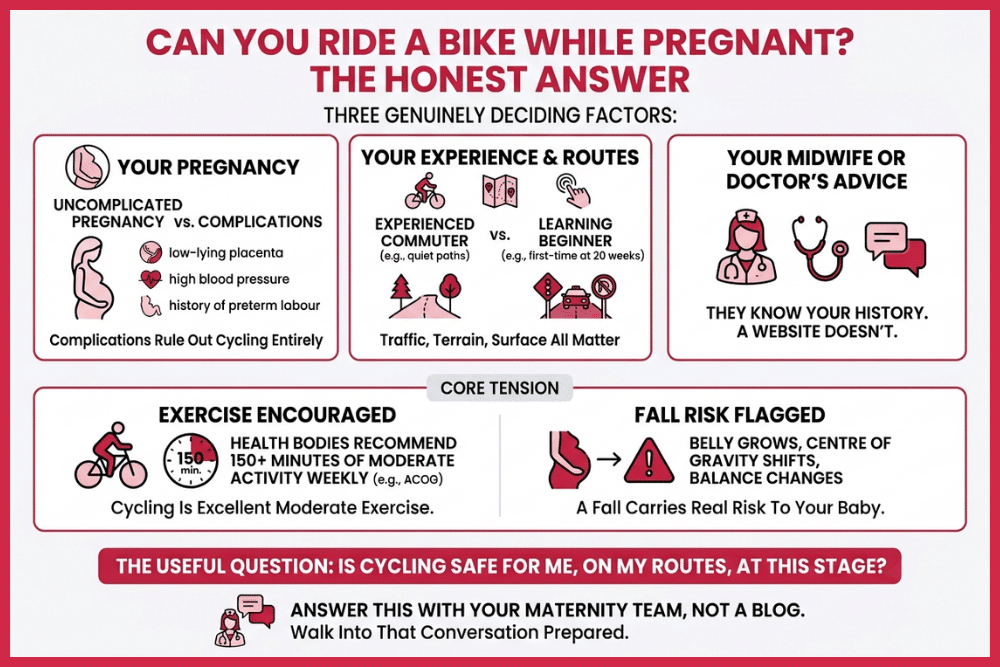
Here’s the answer nobody wants to give you: it depends.
That sounds like a cop-out. It isn’t. Three things genuinely decide this, and they’re different for every rider.
1. Your pregnancy. An uncomplicated pregnancy is a completely different situation from one involving a low-lying placenta, high blood pressure, or a history of preterm labour. Some conditions rule out cycling entirely.
2. Your experience and your routes. Someone who commutes 60 miles a week on quiet paths is not in the same position as someone learning to ride for the first time at 20 weeks. Traffic, terrain, and surface all matter.
3. What your midwife or doctor says. They know your history. A website doesn’t.
Here’s the tension at the heart of this topic. Health bodies strongly encourage exercise in pregnancy. The American College of Obstetricians and Gynecologists (ACOG) recommends at least 150 minutes of moderate activity a week for uncomplicated pregnancies. Cycling is excellent moderate exercise.
But those same bodies flag cycling as a fall risk. As your belly grows, your centre of gravity shifts and your balance changes. A fall carries real risk to your baby, which is why the guidance urges caution.
So the useful question isn’t “is cycling safe in pregnancy?” It’s “is cycling safe for me, on my routes, at this stage?”
That’s a question you answer with your maternity team, not a blog. What I can do is give you the information to walk into that conversation properly prepared.
What the Medical Guidelines Actually Say
A lot of articles cite the bits of the guidance that suit their angle. Here’s the full picture from the main bodies.
1. What ACOG Says
ACOG lists stationary bicycling among the exercises considered safest during pregnancy. Their reasoning is direct: because your growing belly can affect your balance and make you more prone to falls, riding a standard bicycle during pregnancy can be risky, so a stationary bike is a better choice
They also list off-road cycling under activities that may result in a fall and should be avoided, alongside downhill skiing, surfing, gymnastics, and horseback riding. On intensity, ACOG has moved away from heart-rate targets.
Because heart-rate responses during exercise can be blunted or unusual in pregnancy, they recommend using ratings of perceived exertion instead, aiming for 13 to 14 (somewhat hard) on the Borg scale, or simply the talk test: if you can hold a conversation, you probably aren’t overdoing it.
If you’ve read that old “keep your heart rate under 140″ rule somewhere, it’s outdated.
2. What the NHS and RCOG Say
The UK guidance lands in a similar place.
The NHS advises keeping up your normal exercise for as long as you feel comfortable, but says activities with a risk of falling, including cycling, should only be done with caution, because falls carry a risk of damage to your baby.
It also advises not exhausting yourself, and uses the same conversation-based intensity check. RCOG’s wording is blunter. It cautions women about the potential for loss of balance and fetal trauma from horseback riding, downhill skiing, ice hockey, gymnastics, and cycling.
So cycling gets grouped with skiing and horse riding. That surprises a lot of people.
3. Why This Advice Frustrates Experienced Cyclists
If you cycle regularly, that grouping probably feels wrong. Your daily commute on a segregated path isn’t downhill skiing.
You’re not alone in thinking so. Research published in the Journal of Transport & Health found that ambiguously worded or overly cautious advice from medical guidelines, midwives, and obstetricians was a key reason women stopped cycling during pregnancy.
The guidance is written broadly, so it has to cover the nervous beginner and the seasoned commuter with one sentence. That’s why a personal conversation with your maternity team beats any general rule.
When Cycling Is Not Safe During Pregnancy
Some conditions make exercise unsafe in pregnancy, full stop. If any of these apply to you, cycling is off the table until your doctor says otherwise.
ACOG lists these as absolute contraindications to aerobic exercise during pregnancy:
- Significant heart disease (specifically, heart disease affecting blood flow)
- Restrictive lung disease
- A weak or shortened cervix, or a cervix that has been stitched (cerclage)
- Carrying twins or more, where there’s a risk of premature labour
- A low-lying placenta (placenta praevia) after 26 weeks
- Preterm labour during this pregnancy
- Waters that have broken early (ruptured membranes)
- Preeclampsia or pregnancy-induced high blood pressure
- Severe anaemia
There are also relative contraindications, meaning conditions where exercise might be possible but only with medical supervision. These include things like poorly controlled type 1 diabetes, poorly controlled thyroid disease, and a history of extremely sedentary living.
This list isn’t exhaustive, and only your doctor or midwife can tell you which category you fall into.
One more thing worth saying plainly. If you’re pregnant and you’ve never cycled before, pregnancy isn’t the time to learn. Balance is already shifting, and building a new skill on two wheels adds risk you don’t need.
Outdoor Cycling vs Stationary Bike: Which Should You Choose?
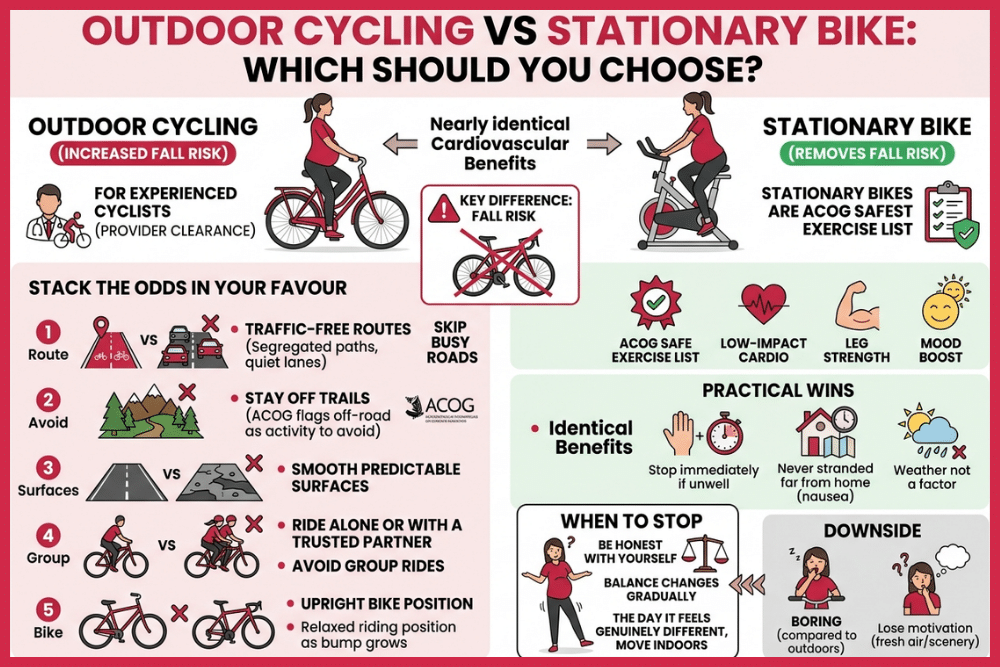
This is the decision most pregnant cyclists actually wrestle with. You get nearly identical cardiovascular benefits from both. The difference comes down to one thing: the risk of falling.
The Case for Switching to a Stationary Bike
A stationary bike removes the fall risk entirely. No traffic, no potholes, no wet leaves, no car doors opening.
That’s exactly why ACOG puts stationary cycling on its list of safest pregnancy exercises while flagging standard bikes as risky. You still get the low-impact cardio, the leg strength, and the mood boost, with none of the crash variables. If you want more on why cycling counts as proper cardio, I covered that in my article ‘Is Biking Cardio’.
A few practical wins too. You can stop the moment you feel off. You’re never stranded miles from home when nausea hits. And weather stops being a factor.
The obvious downside: it’s boring compared to being outside, and plenty of riders lose motivation without fresh air and scenery.
If You Choose to Keep Riding Outdoors
Many experienced cyclists do continue, with their provider’s clearance. If that’s you, stack the odds in your favour:
- Ride traffic-free routes. Segregated paths, quiet lanes, park loops. Skip busy roads.
- Stay off trails. ACOG specifically lists off-road cycling as an activity to avoid.
- Pick smooth, predictable surfaces. Loose gravel, wet roots, and potholes are where falls happen.
- Ride alone or with someone you trust. Group rides mean unpredictable wheels near yours.
- Choose an upright bike. A relaxed riding position beats a stretched-out road position as your bump grows.
And be honest with yourself about when to stop. Balance changes gradually, and the day it feels genuinely different is the day to move indoors.
How Cycling Changes in Each Trimester
Pregnancy isn’t one static experience. What feels fine at 8 weeks can feel impossible at 30. Here’s roughly what shifts, though bear in mind everyone’s timeline is different.
First Trimester
Your bump hasn’t arrived yet, so balance is largely unchanged. If you cycled before and your pregnancy is uncomplicated, this is usually the stage that changes least.
The obstacles are different ones. Nausea and exhaustion hit hardest in these early weeks, and plenty of riders find they simply don’t want to be on a bike. That’s normal and it isn’t a fitness failure.
Overheating matters most now too. ACOG advises avoiding getting overheated especially in the first trimester, so skip rides in very hot or humid weather and keep water handy.
Second Trimester
Many people feel best here. Nausea often eases, energy returns, and the bump is still small enough that riding feels fairly normal.
But this is when your centre of gravity genuinely starts moving. Handling changes subtly. Mounting and dismounting gets more awkward than you’d expect.
Bike fit is worth revisiting. Raising your handlebars or shifting to a more upright position takes pressure off your bump and your lower back.
Third Trimester
This is where most riders move indoors, and for good reason. Balance is meaningfully affected, your bump limits how you can position yourself, and a fall now carries the most risk.
Pelvic pressure becomes a real factor too. As your pelvis widens and shifts in late pregnancy, sitting on a saddle can increase pressure on your pelvic floor. If you feel any heaviness, dragging, or discomfort down there, stop and speak to your midwife or a women’s health physio.
Some people ride comfortably right up to the end. Many don’t. Both are completely normal.
Safety Tips If You Ride While Pregnant
Cleared to ride? These are the adjustments that matter most.
1. Use the talk test, not a heart rate number. If you can hold a conversation while riding, you’re at a sensible intensity. ACOG recommends this over heart-rate targets because heart-rate responses can behave unpredictably in pregnancy.
2. Don’t let yourself overheat. Pregnancy makes temperature regulation harder. Skip rides in hot, humid weather, ride early or late in summer, and wear loose, breathable layers.
3. Drink more than you think you need. Before, during, and after. Dizziness and a pounding heart are signs you’ve fallen behind.
4. Keep rides shorter. Some NHS guidance suggests capping exercise sessions at around 45 minutes, particularly in hot or humid conditions. Two short rides beat one long one.
5. Raise your bars and check your fit. A more upright position eases pressure on your bump, lower back, and pelvic floor. A padded or cut-out saddle can help as your pelvis shifts.
6. Service your bike properly. Brakes and tires matter more than ever when your reaction margin is smaller. My bike maintenance guide covers the checks worth doing.
7. Carry your phone and tell someone your route. Simple, and worth doing every ride.
Warning Signs That Mean Stop Riding Immediately
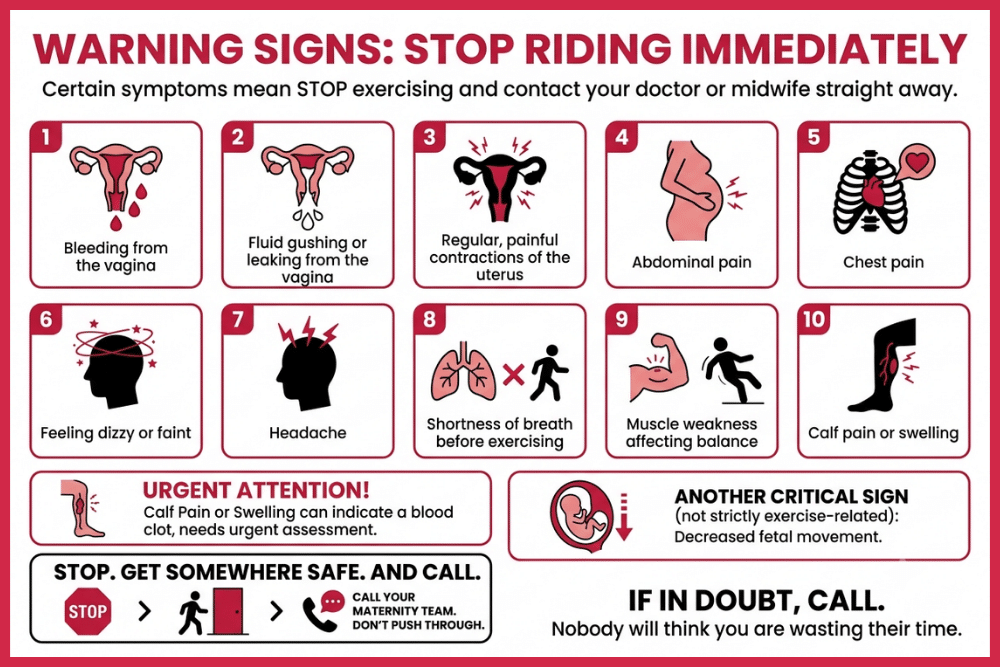
Whatever stage you’re at, some symptoms mean stop exercising and contact your doctor or midwife straight away. ACOG lists these warning signs:
- Bleeding from the vagina
- Fluid gushing or leaking from the vagina
- Regular, painful contractions of the uterus
- Abdominal pain
- Chest pain
- Feeling dizzy or faint
- Headache
- Shortness of breath before you start exercising
- Muscle weakness affecting your balance
- Calf pain or swelling
Two of these deserve extra attention. Calf pain or swelling can indicate a blood clot, which needs urgent assessment. And decreased fetal movement is another reason to stop and call, even though it isn’t strictly an exercise symptom.
Don’t try to push through any of these. Don’t wait to see if it settles on the way home. Stop, get somewhere safe, and call your maternity team.
If you’re ever unsure whether something is serious, call. Nobody on a maternity line will think you’re wasting their time.
Questions to Ask Your Midwife or Doctor
“Ask your doctor” is useless advice without knowing what to ask. Appointments are short, and vague questions get vague answers.
Take these with you:
1. “Is there anything in my history or this pregnancy that rules out cycling?” This gets you a direct answer on contraindications rather than general caution.
2. “I currently ride [X] miles a week on [describe your routes]. Is that reasonable to continue?” Specifics matter enormously. Say whether it’s a segregated path or a busy road.
3. “What intensity should I aim for?” Confirms the talk test applies to you and flags any reason to go easier.
4. “Are there signs specific to me that I should watch for?” Useful if you have any risk factors at all.
5. “At what point would you want me to switch to a stationary bike?” Gives you a marker to work towards instead of guessing.
Worth writing these down beforehand. It’s easy to forget half of them once you’re in the room.