Dealing with sore knees and wondering whether cycling will help or hurt? Or did your knees start aching after you took up riding? Either way, I dug through the research, from knee implant studies to a 2,600-person study on lifetime cycling, to get you a straight answer.
Biking is good for knees because it is low-impact, loads the joint less than walking, and builds the muscles that support it. Lifelong cyclists report less knee pain, and arthritis experts recommend it. Knee pain from cycling usually stems from overuse or poor bike fit, especially saddle height.
Below, you’ll see what the research says, how to pinpoint what’s causing your knee pain, and the bike setup that protects your knees.
Is Biking Good for Your Knees? Here’s What the Research Says
Biking is good for most people’s knees. It loads the joint far less than walking, lifelong riders report less knee pain, and pedaling strengthens the muscles that protect your knees.
That’s not gym folklore, either. The research backs it up.
Cycling Puts Far Less Load on Your Knees Than Walking
How do you measure the force inside a living knee? You build sensors into it.
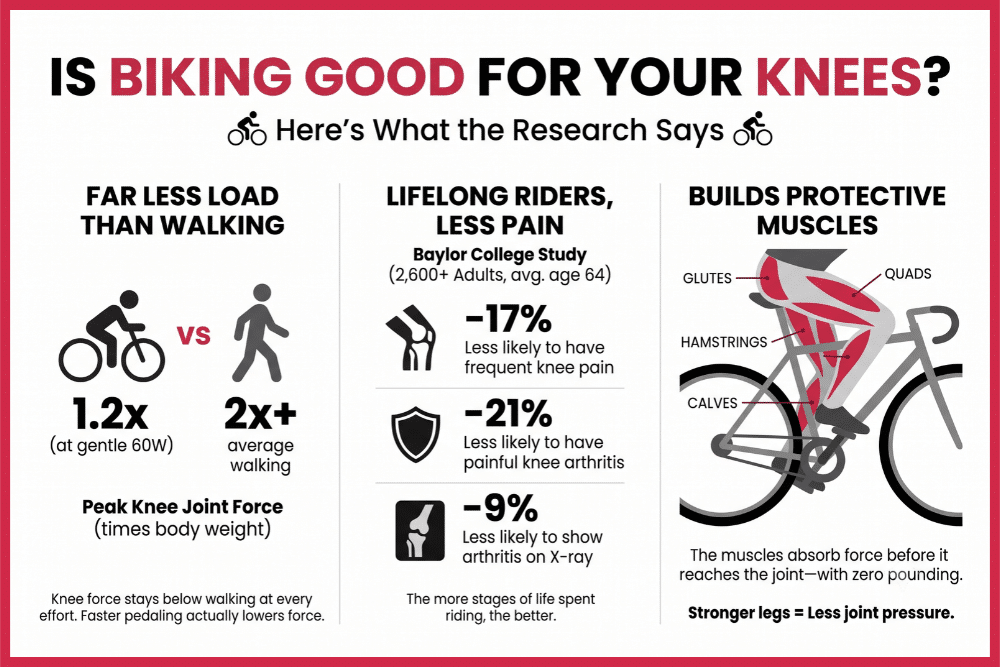
Researchers did exactly that. They tracked 9 people with sensor-fitted knee replacements on an exercise bike. At a gentle 60 watts, peak knee force was about 1.2 times body weight.
A separate implant study found that walking puts 2 times your body weight or more through the same joint.
Two more findings jumped out at me:
- Knee force rose as riders pushed harder, but it stayed below walking at every effort level tested.
- Pedaling at a quicker cadence actually lowered the force.
That second one is a free knee upgrade. I’ll show you how to use it later.
Lifelong Riders Report Less Knee Pain
A 2024 study led by Baylor College of Medicine asked more than 2,600 adults (average age 64) about their cycling habits from age 12 onward.
Compared with non-cyclists, riders were:
- 17% less likely to have frequent knee pain
- 21% less likely to have painful knee arthritis
- 9% less likely to show arthritis on an X-ray
And the more stages of life someone spent riding, the better their knees tended to be.
One honest caveat: this is an observational study. It shows a link, not proof.
Still, co-author Jeffrey Driban’s takeaway was clear: “we certainly should avoid recommending against bicycling.” Decades of riding don’t appear to wear knees out.
Pedaling Builds the Muscles That Protect Your Knees
Your knee doesn’t handle force alone. The muscles around it, especially your quads, hamstrings, and glutes, help absorb load before it reaches the joint.
Cycling trains all of them with zero pounding. The downstroke works your quads and glutes. Your hamstrings and calves pitch in as the pedal sweeps through the bottom.
Sheena Alva, a physical therapist at New York’s Hospital for Special Surgery, told the Arthritis Foundation that stronger leg muscles “better support the joints and relieve some of the pressure.”
Low-impact cardio plus knee-friendly strength work. Hard to beat that combo.
Is Cycling Good If You Already Have Knee Problems?
Cycling is usually a smart choice if you already have knee problems. The Arthritis Foundation recommends it for arthritic knees, and orthopedic surgeons recommend it after knee replacement. The secret is starting gently.
Cycling With Knee Arthritis
A 2021 review pooled the research on stationary cycling for knee osteoarthritis. The verdict: cycling eased pain and improved sport and exercise function.
To be fair, gains in stiffness and day-to-day function were small. Pain relief was the clear win.
And you don’t have to go hard. Research cited by the Arthritis Foundation found gentle cycling eased pain just as well as intense riding.
Here’s the Arthritis Foundation’s starting plan:
- Ride about 20 minutes, 3 to 5 days a week (5-minute sessions count too)
- Start with no resistance. Add speed first, then resistance.
- Rate your knee pain from 0 to 10 before and after each ride
That last one is gold. If your pain jumps more than 2 points, you overdid it. Take 2 days off, then come back at half the effort.
Bonus: pedaling may also help keep the joint lubricated.
Cycling After Knee Replacement or Surgery
Just had a knee replacement? A stationary bike may well be part of your rehab.
The American Academy of Orthopaedic Surgeons (AAOS) says your doctor may have you ride one during physical therapy to keep your muscles toned and your knee flexible. Later on, AAOS lists bicycling among the low-impact activities it prefers over high-impact ones like jogging and jumping.
The catch? Wait for your surgeon’s go-ahead. As AAOS puts it, “the key is to not do too much, too soon.”
Had a different knee surgery, like a ligament repair? Your surgeon or physical therapist sets the timeline. Stick to it.
Can Cycling Cause Knee Pain?
Cycling can cause knee pain, but it’s usually an overuse problem, not an impact injury. A review in the AAOS journal lists knee pain among cycling’s common, preventable injuries. It blames poor preparation, the wrong equipment, bad technique, and overuse. Its main prevention advice starts with bike fit.
Even the pros aren’t immune. In a study of 109 professional road cyclists, 36% had pain at the front of the knee over the previous year. Knee problems also made up 57% of the injuries that cost riders time off the bike.
If riders with team mechanics get sore knees, the rest of us can cut ourselves some slack.
The good news? Where it hurts usually tells you why.
| Where It Hurts | Likely Cause | First Fix to Try |
|---|---|---|
| Front (around the kneecap) | Saddle too low or too far forward | Raise the saddle a little. Spin lighter gears. |
| Back of the knee | Saddle too high, so your leg straightens too far | Lower the saddle slightly |
| Outside of the knee | Saddle too high or poorly set cleats, irritating the IT band (the tissue running down your outer thigh) | Lower the saddle a touch. Recheck your cleats. |
| Inside of the knee | Knee drifting inward as you pedal | Strengthen your hips and glutes. Try insoles or shoe wedges. |
One rule: change one thing at a time, then ride a few times before you judge it. Riders respond differently to fit changes.
Sharp pain, swelling, or pain that won’t settle? Skip the DIY fixes. I cover those warning signs at the end of this guide.
How to Set Up Your Bike So It Protects Your Knees
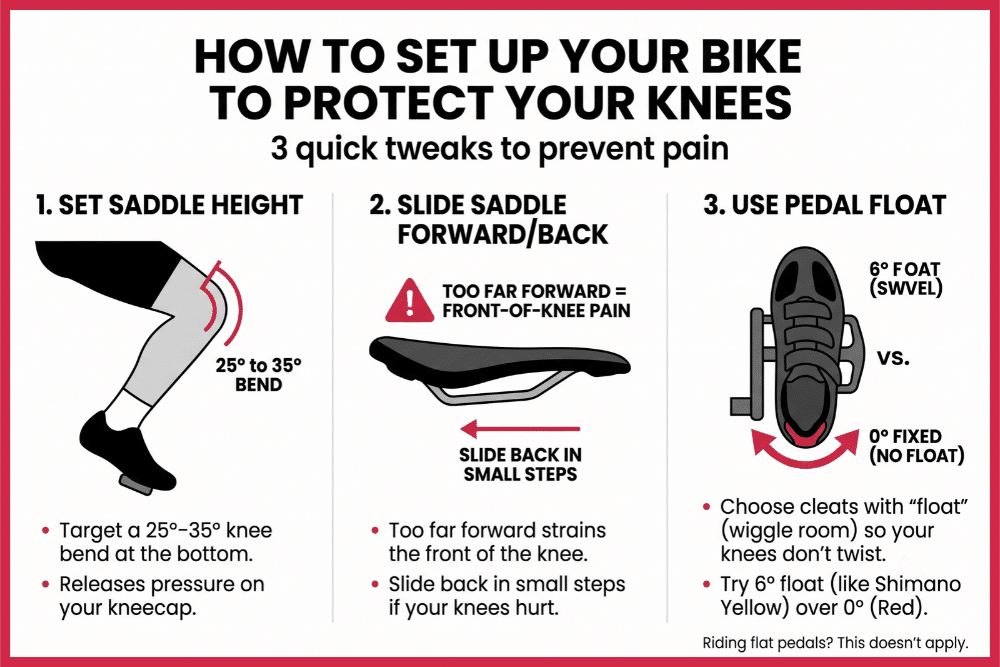
Bike fit is the cheapest knee insurance there is. These three tweaks need a multi-tool and a friend with a phone.
Set Your Saddle Height for a 25 to 35 Degree Knee Bend
Saddle height matters most. A 2011 review in Sports Medicine found that a 5% change in saddle height changed knee movement by 35%.
Your target: a 25 to 35 degree bend in your knee at the bottom of the pedal stroke. A straight leg is zero degrees.
The review recommends 25 to 30 degrees, and a higher saddle eases pressure on your kneecap. Less flexible riders often feel better closer to 35.
To check yours, pedal to the bottom with your foot level. Have a friend take a side-on photo, then measure it with a free angle app. If the app shows the inside angle, subtract it from 180. So 150 degrees means a 30 degree bend.
Slide Your Saddle Forward or Back to Match Your Pain
Front-to-back position counts too. The University of Miami’s sports medicine team links a saddle that’s too far forward with front-of-knee pain. If that’s you, slide it back in small steps.
One catch: moving the saddle back stretches your leg a little more, almost like raising it. Recheck your knee angle after every move.
Line Up Your Cleats and Give Your Knees Some Float
Clipless pedals lock your foot in place. If the cleat angle fights your natural foot angle, your knee twists slightly on every stroke. That’s thousands of times per ride.
That’s where float helps. It lets your heel swivel a few degrees before the cleat releases.
Shimano’s yellow road cleats give 6 degrees of float, and Shimano suggests them for riders with knee pain. Its red cleats give zero.
The honest caveat: sports physiotherapists note there’s no direct proof that float prevents injury. But it’s cheap, and it gives your knees some wiggle room.
Set each cleat so your foot sits at its natural angle, centered in the float.
Riding flat pedals? Your feet aren’t locked in, so this one doesn’t apply.
6 Riding Habits That Keep Your Knees Happy
Fit is half the battle. How you ride is the other half.
1. Spin lighter gears. Remember that free knee upgrade? This is it. Grinding a big gear uphill feels heroic, but your knees disagree. The implant study showed knee force dropping as cadence rose. So shift down and let your legs spin. My gear ratio calculator shows how easy each gear really is.
2. Build mileage slowly. Sudden jumps in riding are a classic knee pain trigger. Sports physical therapists flag the first rides back after a winter break as a high-risk time. Add distance and intensity gradually.
3. Strengthen your glutes and quads off the bike. Weak glutes make your quads work harder, which can overload the front of your knee, the same experts note. Two short strength sessions a week, with moves like bridges and step-ups, help even things out.
4. Use the 0 to 10 pain check. It’s not just for arthritic knees. Rate your knee pain before and after each ride. If it climbs more than 2 points, back off.
5. Push and pull through each stroke. The Arthritis Foundation warns that pushing alone overworks your quads and may trigger a flare-up. At the bottom of the stroke, sweep your foot back like you’re scraping mud off your shoe.
6. Never lock out your knee. Your leg should never go fully straight at the bottom of the stroke. If it does, your saddle’s too high. Redo the photo check.
Stationary Bike or Outdoor Riding: Which Is Easier on Your Knees?
A stationary bike is usually easier on sore knees, because you control the resistance and never meet a hill you can’t spin up. Outdoor riding works too, as long as you choose flatter routes and stay in easy gears.
A few tips if you’re riding indoors:
- Go recumbent if balance is an issue. Physical therapist Jessica Schwartz told the Arthritis Foundation that recumbent bikes are more stable and comfortable.
- Watch out in spin classes. Sheena Alva, the HSS physical therapist from earlier, warns that people get into trouble by pushing too hard. Leave your ego at the door.
Outside, the danger is hills. A steep climb forces a big effort, and the implant study showed knee force rising with effort.
My take: sore knees? Start indoors. Once your 0 to 10 pain check stays steady, take it outside.
Is Biking Better for Your Knees Than Walking or Running?
Biking is the gentlest of the three on your knees. At a normal effort, it puts the least force through the joint, with zero impact. But walking and running win on one thing. The Bone Health & Osteoporosis Foundation notes that biking isn’t weight-bearing, so it does less for your bones.
| Factor | Biking | Walking | Running |
|---|---|---|---|
| Knee force | About 1.2x body weight (easy effort) | 2x body weight or more | Highest of the three |
| Impact | None | Low | High |
| Builds bone? | Not much (not weight-bearing) | Yes (brisk walking) | Yes |
| Best for | Sore, arthritic, or recovering knees | Everyday movement and bone health | Healthy knees, built up gradually |
Running deserves a fair shake, though. A 2017 review found hip or knee arthritis in 3.5% of recreational runners, compared with 10.2% of inactive people. Elite, high-mileage runners came in at 13.3%. It’s a link, not proof, but casual running doesn’t look like the knee wrecker people assume.
Already have sore knees? Running’s impact makes it a rough place to start.
My take: bike for your knees, walk for your bones. I break down that pairing in my biking vs walking guide.
Knee Pain That Needs a Doctor, Not a Saddle Tweak
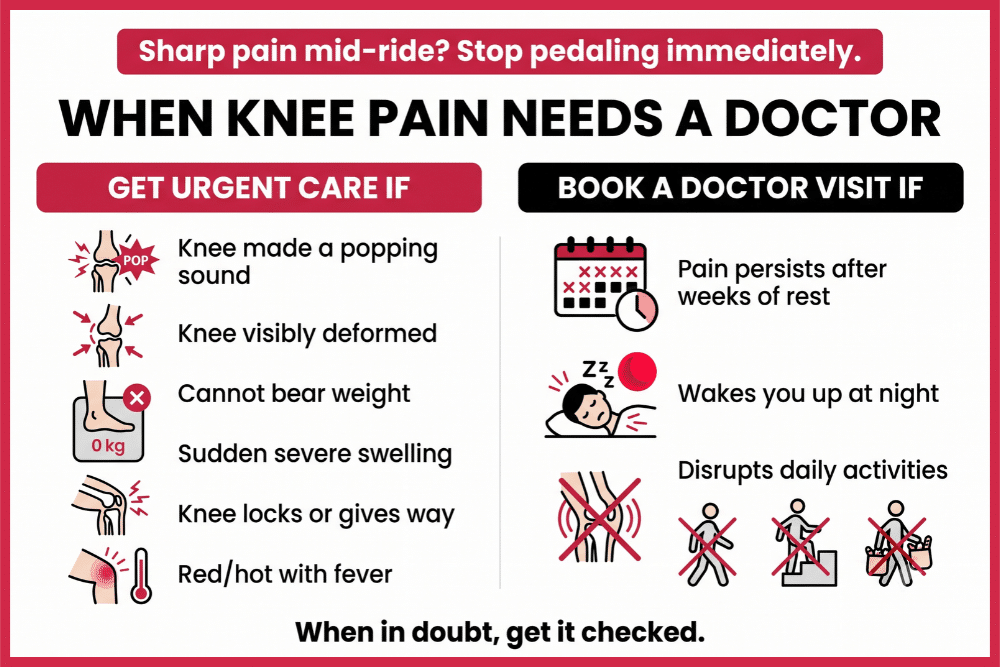
Most cycling knee pain is a fit or training problem. But some symptoms point to an injury or infection that no saddle tweak will fix. And if you feel sharp or shooting pain mid-ride, the Arthritis Foundation says to stop pedaling.
Stop riding and get urgent care if:
- You heard a pop when you crashed or twisted your knee
- Your knee looks bent or out of shape
- It won’t take your weight
- It swelled up suddenly or the pain is severe
- It locks or gives way
- It’s red and hot, and you have a fever
Book a doctor’s visit if:
- The pain hasn’t improved after a few weeks of rest and easy riding
- It wakes you up at night or gets in the way of daily life
Both lists come from Mayo Clinic and the NHS. When in doubt, get it checked. A quick appointment beats months of riding through a problem.